

Farrier Science and Business Program Description
Hocking College is one of only a small number of institutions in the country to offer an Associate Degree in Farrier Science-and the only farrier school in the state of Ohio. This distinctive Farrier Science and Business program allows students the opportunity to turn a passion for horses into a specialized, in-demand career by combining hands-on farrier training, blacksmithing, and essential business education for long-term success in the equine industry.
Students gain a strong foundation in the science of the equine hoof and lower limb while learning modern, safe, and industry-standard shoeing techniques. In addition to corrective and performance shoeing, students are taught forging techniques, enabling them to shape, modify, and build shoes and tools with confidence. Courses in horse handling and management, equine health, and nutrition further strengthen students' understanding of complete horse care. As part of their real-world training, farrier students also work with outside clients, building professionalism and hands-on experience before graduation.
Because many farriers are self-employed, the program places strong emphasis on business preparation. Students develop practical skills in management and accounting, marketing development, and business practices specific to the equine industry-giving graduates the tools they need to establish, operate, and grow a successful farrier business.

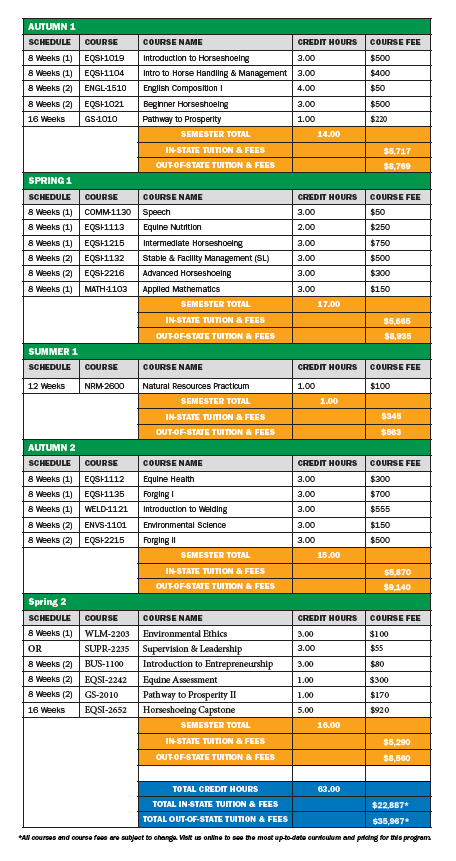
Hocking College offers all-inclusive pricing and works with students to assure they have complete college funding, including financial aid, before they start classes. Please reference the course curriculum tab for program costs.
All-inclusive pricing includes the following:
PER SEMESTER
$300......Learning Fee
$20........Health Center Services
$75........Career Center Services
Not included in the All-Inclusive Pricing
$53......Parking
Pricing for housing and meal plans can be found here.
A Career in Farrier Science and Business Promises an Exciting Future
Graduates of Hocking College's Farrier Science and Business program are prepared for a wide range of careers within the equine industry. Many alumni go on to work as professional farriers, providing hoof care, corrective and therapeutic shoeing, and performance shoeing for a variety of horses. With training in blacksmithing, graduates are also equipped to fabricate and modify shoes and tools to meet the specific needs of each horse.
Because the program emphasizes business management and equine-specific marketing, graduates are well prepared for self-employment, allowing them to build and manage successful farrier businesses. Additional career pathways may include working with veterinary practices, training and performance barns, equine rehabilitation facilities, or supporting roles within the broader equine and agricultural industries. This combination of technical skill, horse care knowledge, and business preparation gives graduates the flexibility to pursue diverse and sustainable careers in hoof care and equine services.

Student Learning Outcomes (SLOs) are statements of what a student will be able to do when they have completed a program. They represent the knowledge and skills a program has determined are most important for students to gain from that program and include both the Success Skills (institutional outcomes) and Program Outcomes. SLOs are specific and measurable so the program can accurately assess the degree to which students have achieved each outcome, and they align with college and institution mission and values. Data on the achievement of SLOs is used to make improvements in the program and increase student success.
Hocking College Institutional Learning Outcomes
1) Demonstrate sound critical thinking, information literacy and technological competency in the production of academic writing and presentations
2) Apply the methods of mathematical, statistical or analytical reasoning to critically evaluate data, solve problems and effectively communicate findings.
3) Demonstrate an awareness of the social, political and economic forces which shape individuals, institutions and communities in the modern world.
4)Understand social justice and the diversities and complexities of the cultural and social world past and present and come to an informed sense of self and others.
5)Demonstrate a foundation of knowledge in the natural sciences based on theory and laboratory skills.
6) Cultivate ethical values, personal wellness and personal learning strategies in the development of the whole person, mind, body and spirit.
7) Integrate content material to application in the workforce and apply discipline specific knowledge and skills to successfully transfer or effectively meet the expectations of internships, workplace, volunteerism and/or entrepreneurship endeavors.
8) Utilize the ethical and professional application of current information technology and tools effectively.
Student Learning Outcomes
The following student learning outcomes are skills, behaviors, and attitudes cultivated in students seeking the Associate of Technical Study in Farrier Science and Business:
- Perform proper horse hoof care including trimming, balancing hooves, and shoeing techniques.
- Apply business skills as they pertain to the equine industry.
- Identify, maintain, and use safety procedures with horses, tack and related equipment.
- Perform safety inspection procedures in daily operations.
- Properly feed/water horses, groom/bathe horses, and clean stalls.
- Provide basic horse health care including preventive health care.
- Properly identify feeds and feeding requirements of equine at all ages and levels of performance.
- Apply knowledge of horse anatomy, teeth identification, conformation color, and health care.
- Manage horses unmounted, to include leading, tying, trailer loading, transporting, approaching catching, and haltering.
- Operate and maintain basic farrier equipment.
- Demonstrate correct use of forge.
- Develop a plan to establish a farrier business.
Program Learning Outcomes
- PLO 1 - Safe Horse Handling & Preparation
Demonstrate safe and effective horse handling skills—including haltering, leading, tying, loading, and restraint-to prepare horses for trimming and shoeing procedures. - PLO 2- Hoof Trimming & Balance
Apply hoof anatomy and growth principles to properly trim and balance equine hooves in support of soundness and performance. - PLO 3-Horseshoeing & Therapeutic Applications
Fabricate, fit, and apply horseshoes, including modified and therapeutic shoes, to address normal and special hoof care needs. - PLO 4- Equine Health, Nutrition & Limb Function
Analyze equine anatomy, physiology, nutrition, and basic health conditions to support hoof care decisions and overall equine well-being. - PLO 5-Forging & Welding Skills
Demonstrate proficiency in forging and welding techniques-including hand forging, forge welding, arc, MIG, and oxy-acetylene processes-to produce functional farrier tools and horseshoes. - PLO 6- Professional & Business Practices
Develop and implement ethical, professional, and financial practices necessary to operate a sustainable farrier business within the equine industry.

Retention Rates
- All registered fall/autumn students with registration status for the following fall/autumn.
- Excludes special populations - College Credit Plus, Non Degree, Online Military and University Center.
Potential for upcoming fall/autumn excludes graduates from that fall/autumn, spring and summer terms.
| Academic Year | Retention Rate |
| 2024 - 2025 | 87.5% |
| 2023 - 2024 | 33% |
| 2022 - 2023 | 67% |
Graduation Rates
Graduation rates are determined by the office of Institutional Research. To ensure appropriate time for data collection, this report will be run and posted annually in the last week of September for the previous academic year. It should be noted that annual graduation rates may change as students continue to graduate. The following criteria will be utilized for the calculation of graduation rates:
- Overall Program Completion Rate is defined as a percentage of the ratio:
All graduates of the program
_________________________________________________________________
All students with the program in their history of programs of study - For the purposes of reporting, the program completion rates are aggregated by academic year of entry.
- A student is considered to have completed or graduated from a program or certificate by virtue of having been awarded the degree or certificate.
- A student is considered to be undertaking activity in a program of study for the duration of time that they are in an active status in a program or certificate. This is defined by having a Program of Study with a status of ‘A’ during the duration of time they are taking coursework. Should a student move in and out of active status in a program of study while continuing to take coursework, we only take into account the student’s activity while the program has an active status for that particular program of study.
| Academic Year | Graduation Rate |
| 2024 - 2025 | 38% |
| 2023 - 2024 | 27% |
| 2022 - 2023 | 50% |
We consistently need sound, capable horses to teach our students on a daily basis. Horses should be discipline-appropriate with suitable prior experience. Because our programs serve students of all experience levels, we accept horses from the walk-trot/jog-canter/lope level through advanced performance horses, including reiners and cow horses.
We are in need of horses that are fit and sound, well trained in their discipline and preferably under 18 years old. Our school horses generally work one to two hours per day and four to five days per week. In order to ensure a good fit between donated horses and our needs, we ask that the owner always communicate with the college by phone or email.
We ask that donated horses meet the following qualifications;
- Between the ages of 2 and 18 years old.
- Reach a mature height of at least 15 hands high.
- Be serviceably sound for its intended purpose.
To learn more about our donation process, please visit www.hocking.edu/horse-donation.
