

Dental Hygiene Program Description
Perry Campus- 5454 OH-37, New Lexington, OH 43764
 The next Dental Hygiene class begins in Autumn 2026. Admission requires a two-step process:
- Apply to Hocking College
- Complete the Preclinical Courses (listed under the "Course Curriculum" section)
- Complete the separate Dental Hygiene Program application (see “Program Application” section)
Dental Hygiene Application Informational Session
We know how stressful the application process can be—so many questions and concerns. We’re here to support you every step of the way.
You are invited to attend a virtual information meeting on Wednesday, March 4th at 5:00 pm. During this session, you’ll receive all the essential information about the Hocking College Dental Hygiene Program application process, followed by a question-and-answer session.
To attend, please follow the URL listed here at the scheduled time. We look forward to connecting with you and helping you navigate the next steps.
Hocking College Dental Hygiene Program Application Information Meeting Room

Students who successfully complete two years of full-time study will earn the Associate of Applied Science in Dental Hygiene. The curriculum encompasses four primary areas of study: General Education, Biomedical Sciences, Dental Sciences, and Dental Hygiene Sciences. These courses provide students with a comprehensive foundation in oral anatomy and development, pathology, disease prevention and progression, and treatment modalities.
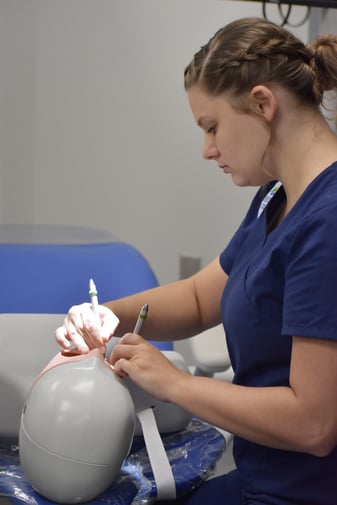
The program places strong emphasis on professional and ethical interactions with patients and other healthcare providers. Students also develop effective communication skills through direct patient care experiences in Hocking College’s on-site dental clinic, located at the Perry Campus New Lexington, Ohio.
During the final semester of the program, dental hygiene students will complete the National Board Dental Hygiene Examination (NBDHE) administered by the Joint Commission on National Dental Examinations (JCNDE), the CDCA-WERB-CITA Dental Hygiene Board Examination, the CDCA-WREB-CITA Local Anesthesia Board Examination, and the Ohio State Dental Board (OSDB) Jurisprudence Examination. Upon graduation, and successful completion of all required board examinations, dental hygiene students are eligible to apply for licensure through the Ohio State Dental Board.
After fulfilling all program application requirements, students may apply for admission to the Dental Hygiene Program.
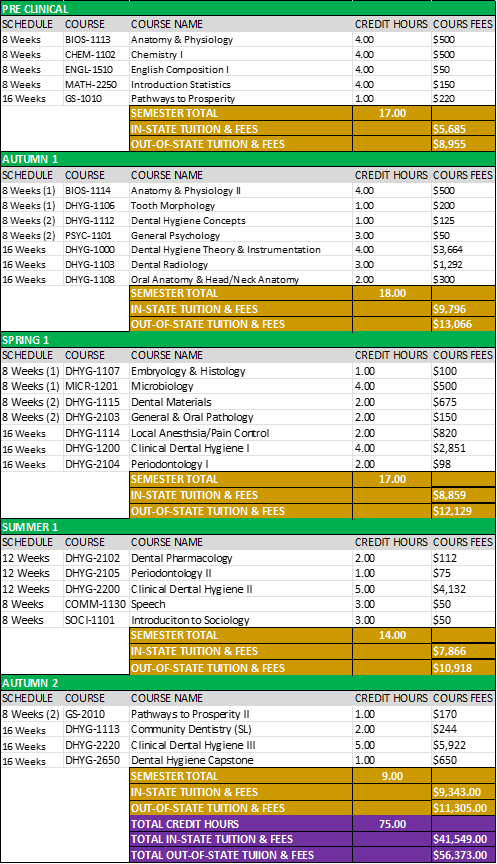
Hocking College offers all-inclusive pricing and works with students to assure they have complete college funding, including financial aid, before they start classes. Please reference the course curriculum tab for program costs.
All-inclusive pricing includes the following:
PER SEMESTER
$300......Learning Fee
$20........Health Center Services
$75........Career Center Services
$140......Anesthesia Board
$455......NDHBE
OPTIONAL
$53......Parking
Pricing for housing and meal plans can be found here.
A Career in Dental Hygiene Provides a Smiling Opportunity
As the population ages and research continues to highlight the strong connection between oral health and overall health, the demand for dental services is expected to grow steadily. This creates excellent opportunities for those pursuing a career in dental hygiene.
The U.S. Bureau of Labor Statistics projects that employment of dental hygienists will grow 7% from 2024 to 2034, faster than the average for all occupations. Each year, an estimated 15,300 positions for dental hygienists will open nationwide as the need for oral health care expands. In 2024, the median annual salary for dental hygienists was $94,260, reflecting both the value of the profession and the expertise required to provide high-quality patient care.
Performance Expectations
To succeed in the dental hygiene program and in professional practice, students should be prepared to demonstrate the following abilities:
- Professionalism – Maintain ethical, responsible, and respectful behavior always
- Visual Acuity – Accurately identify subtle changes in oral tissues
- Hearing Ability – Understand spoken communication without relying on visual cues
- Physical Endurance – Remain seated for extended periods while providing patient care
- Repetitive Motion – Perform precise wrist and hand movements required for instrumentation
- Manual Dexterity – Demonstrate fine motor skills necessary for clinical procedures
- Mobility – Work effectively in small or restricted clinical spaces
- Communication Skills – Communicate clearly and effectively, both in writing and verbally
- Technology Skills – Use computers and digital systems for patient records, charting, and scheduling
Public Disclosure of Licensure
Hocking College offers courses, associate degrees, and certificate programs that may lead to professional licensure, registration, or certification. While these programs meet the requirements for the State of Ohio, standards may differ in other states and jurisdictions. Students living outside Ohio, or planning to relocate, are responsible for confirming specific requirements with the appropriate licensing or certifying authority. Please contact the appropriate administering body and/or the college contact for the program to discuss your intentions.
The following outcomes reflect the knowledge, skills, behaviors, and professional attitudes developed by students pursuing the Associate of Applied Science in Dental Hygiene. Upon successful completion of the Dental Hygiene Program, graduates will demonstrate the ability to:
- Apply theoretical principles and perform procedures relevant to
the dental hygiene practice, routinely self-assessing performance abilities to ensure a high standard of care. - Determine the need and extent of patient-centered treatment utilizing critical thinking skills, including radiographic exposure, routine preventative procedures, periodontal therapy procedures, referral for additional assessment and/or treatment, response to medical/dental emergencies, and all other treatment needs.
- Utilize the dental hygiene process of care in the prevention and/or treatment of oral diseases: assessment, dental hygiene diagnosis, planning, implementation, evaluation, and documentation.
- Apply oral health literacy utilizing analysis of current research literature to provide oral and overall health promotion to individual patients and the community using evidence-based information.
- Utilize standard precautions for infection control during all phases of appointment planning, patient interaction, and treatment.
- Discern and manage ethical issues (using Dental Hygiene Code of Ethics and federal and state laws), exercise sound clinical judgment, and collaborate with diverse populations of professionals and patients.
Student Learning Outcomes (SLOs) articulate the knowledge, skills, and competencies students are expected to demonstrate upon completion of a program. They identify the essential learning priorities established by the program and encompass both institutional outcomes (Success Skills) and program-specific outcomes. SLOs are designed to be specific and measurable, enabling the program to accurately evaluate student achievement. These outcomes are aligned with the mission and values of the college and institution. Assessment data collected on SLOs is used to inform continuous improvement of the program and to enhance overall student success.
Hocking College Institutional Learning Outcomes
1) Demonstrate sound critical thinking, information literacy and technological competency in the production of academic writing and presentations
2) Apply the methods of mathematical, statistical or analytical reasoning to critically evaluate data, solve problems and effectively communicate findings.
3) Demonstrate an awareness of the social, political and economic forces which shape individuals, institutions and communities in the modern world.
4)Understand social justice and the diversities and complexities of the cultural and social world past and present and come to an informed sense of self and others.
5)Demonstrate a foundation of knowledge in the natural sciences based on theory and laboratory skills.
6) Cultivate ethical values, personal wellness and personal learning strategies in the development of the whole person, mind, body and spirit.
7) Integrate content material to application in the workforce and apply discipline specific knowledge and skills to successfully transfer or effectively meet the expectations of internships, workplace, volunteerism and/or entrepreneurship endeavors.
8) Utilize the ethical and professional application of current information technology and tools effectively.
Program Outcomes
The following outcomes represent the essential knowledge, skills, behaviors, and professional attitudes fostered throughout the Associate of Applied Science in Dental Hygiene program. These outcomes reflect the program’s commitment to preparing graduates for competent, ethical, and patient-centered practice. Upon successful completion of the program, graduates will demonstrate the ability to:
- Apply theoretical principles and perform procedures relevant to
the dental hygiene practice, routinely self-assessing performance abilities to ensure a high standard of care. - Determine the need and extent of patient-centered treatment utilizing critical thinking skills, including radiographic exposure, routine preventative procedures, periodontal therapy procedures, referral for additional assessment and/or treatment, response to medical/dental emergencies, and all other treatment needs.
- Utilize the dental hygiene process of care in the prevention and/or treatment of oral diseases: assessment, dental hygiene diagnosis, planning, implementation, evaluation, and documentation.
- Apply oral health literacy utilizing analysis of current research literature to provide oral and overall health promotion to individual patients and the community using evidence-based information.
- Utilize standard precautions for infection control during all phases of appointment planning, patient interaction, and treatment.
- Discern and manage ethical issues (using Dental Hygiene Code of Ethics and federal and state laws), exercise sound clinical
judgment , and collaborate with diverse populations of professionals and patients.
Board Pass Rates
|
ADEX Anesthesia Board Exam |
||
| Graduation Class | Pass Rate | Number of Students |
| Class of 2020 | 100% | 15 |
| Class of 2021 | 100% | 18 |
| Class of 2022 | 94.4% | 18 |
| Class of 2023 | 100% | 17 |
| Class of 2024 | 94.4% | 17 |
| Class of 2025 | 100% | 19 |
|
ADEX Manikin Board Exam (hands-on) |
||
| Graduation Class | Pass Rate | Number of Students |
| Class of2020 | 100% | 15 |
| Class of 2021 | 100% | 18 |
| Class of 2022 | 100% | 18 |
| Class of 2023 | 100% | 17 |
| Class of 2024 | 100% | 17 |
| Class of 2025 | Scheduled 12/2025 | 19 |
|
National Board Dental Hygiene Exam (NBDHE) |
||
| Graduation Class | Pass Rate | Number of Students |
| Class of 2020 | 86% | 15 |
| Class of 2021 | 100% | 18 |
| Class of 2022 | 94.4% | 18 |
| Class of 2023 | 100% | 17 |
| Class of 2024 | 88% | 17 |
| Class of 2025 | Scheduled 11/2025 | 19 |
Testing Policy
Testing is available to all Hocking College students and transfer students applying to the Dental Hygiene Medical Laboratory Technology, or Physical Therapist Assisting.
- Online testing is not permitted.
- Special needs testing is available upon request.
- Prior to beginning the exam, students must inform the proctor of their program choice, as each program requires specialized coding.
barrowsr@hocking.edu
(740) 753-7195
NOTICE: The application deadline for Autumn 2026 will be May 31, 2026.
Dental Hygiene Program Application

Thank you for your interest in the Hocking College Dental Hygiene Program. The curriculum is academically rigorous, scientifically structured, and designed to provide a comprehensive educational experience. Enrollment is limited and determined by facility capacity, established program admission requirements, and a student selection process. These measures ensure that selected students demonstrate the qualifications and potential necessary for successful program completion.
Applicants are expected to carefully review all information contained in this packet and to submit all required materials. Incomplete applications will not be considered. It is the sole responsibility of the applicant to ensure the application is complete prior to submission.
Admission to the Dental Hygiene Program is highly selective and competitive. Selection is based on a rating sheet, which is provided in the application packet. The twenty (20) highest-ranking applicants, as determined by this process, will be offered admission.
Download the BCI & FBI Criminal History Record Check Here
IMPORTANT INFORMATION REGARDING PROGRAM REQUIREMENTS
Performance Requirements for Dental Hygiene Students
To successfully meet the objectives of the Dental Hygiene Program, students must demonstrate the following abilities:
- Professionalism
- Consistently interact in a respectful and professional manner with patients, faculty, peers, employers, and other health care professionals.
- Applications may be denied if unprofessional behavior or attitudes are demonstrated at any time during the admissions process.
- Clinical and Sensory Abilities
- Visually recognize changes in oral tissues and assess the effectiveness of treatment.
- Hear and understand spoken communication without relying on visual cues, and accurately take blood pressure using a stethoscope.
- Physical Abilities
- Sit for extended periods while performing dental hygiene procedures.
- Perform precise, repetitive hand and wrist movements required for instrumentation.
- Move efficiently between treatment rooms and function in confined clinical spaces.
- Communication Skills
- Demonstrate clear written and verbal communication to document patient findings, explain treatment procedures, and provide oral health education.
- Adaptability and Safety
- Function effectively and safely under stressful conditions.
- Adjust to dynamic clinical environments and the demands of patient care.
- Technical Skills
- Use computers, dental software programs, and the internet for patient records, research, and course assignments.
Health and Safety Considerations
Dental health care workers may be exposed to microorganisms present in blood, saliva, respiratory secretions, and aerosols generated during dental procedures. These include, but are not limited to:
- Viruses: Hepatitis B (HBV), Hepatitis C (HCV), Herpes Simplex (Type 1 & 2), Human Immunodeficiency Virus (HIV), COVID-19.
- Bacteria: Mycobacterium tuberculosis, staphylococci, streptococci, methicillin-resistant Staphylococcus aureus (MRSA), and other respiratory pathogens.
Transmission can occur through:
- Contact with contaminated instruments, equipment, or surfaces.
- Exposure to airborne contaminants from droplets or aerosols.
Infection control protocols are rigorously taught, monitored by faculty, and required in all clinical settings to minimize risk.
Immunization and Health Requirements
Prior to entering the Dental Hygiene Program, students must provide proof of the following immunizations (or receive them as required):
- Hepatitis B Vaccination
- Tetanus, Diphtheria, Pertussis (T-DAP)
- Varicella (Chickenpox)
- Measles, Mumps, Rubella (MMR)
- Influenza (annual)
In addition, students must complete:
- Tuberculin Skin Test (Mantoux Method)
- Hepatitis B Titer Test
- Current CPR Certification
Statement Regarding Infectious Diseases
Clinical Setting and Professional Risks
Students enrolled in the dental hygiene program will participate in direct patient care as part of their clinical education. While this hands-on experience is vital for developing professional competence, it also carries inherent risks. Providing care in a clinical setting presents the possibility of exposure to communicable diseases, including—but not limited to—hepatitis, influenza, and other airborne or bloodborne pathogens.
To safeguard both patients and students, comprehensive safety training is provided and strictly enforced. This includes:
- Infection Control Procedures: Students will receive instruction in evidence-based protocols to minimize the risk of disease transmission. Strict compliance is always required.
- Bloodborne Pathogen Training: Students will complete formal training on the risks, prevention strategies, and post-exposure protocols associated with bloodborne pathogens, in compliance with OSHA standards.
- Hazardous Waste Management: Students will be trained in the safe handling, storage, and disposal of biohazardous and chemical waste in accordance with federal, state, and institutional regulations.
Participation in patient care requires students to complete the Hepatitis B vaccination series and maintain current CPR certification throughout the program. Additional immunizations may be recommended in alignment with public health guidelines.
While these measures significantly reduce the potential for exposure, students must understand that no method eliminates risk entirely. Occupational exposure is an inherent aspect of working in healthcare. Professional responsibility, vigilance, and adherence to established safety practices are essential for creating a safe clinical and learning environment.
- Do I need to apply to Hocking College before applying to the Dental Hygiene Program?
Yes, you must first apply to Hocking College as a student before you can submit the selective admission application for Dental Hygiene
APPLY ONLINE - What are the requirements to apply to the dental hygiene program?
Have a high school diploma or GED
Complete the preclinical courses (listed on the course curriculum drop-down
Minimum GPA 2.6
Submit all transcripts from all prior colleges
Complete a TEAs Test at the Nelsonville Testing Center (overall 55 composite score required.
Pass a criminal background check
Current CPR certification
Hepatitis B Vaccination (required by the Ohio State Dental Board) - Is there a waiting list?
No - What happens if I am not accepted?
Students who are not selected may reapply the following year. Many choose to complete additional general educations courses. Please work with your Advisor. - What is the weekly commitment once I am accepted into the Dental Hygiene Program?
Dental Hygiene students should expect to be on the Perry Campus Monday – Friday between the hours of 8am to 5pm. - How long is the program?
Once you have been accepted into the dental hygiene program for 18 months (Semesters: Autumn, Spring, Summer, Autumn) - Can I work while I am in the program?
The program is full-time and includes significant clinical and study requirements. Many students find it difficult to maintain more than part-time employment. - Do I need dental experience before applying?
No - How are applicants accepted?
Through the a rating sheet score. The rating sheet is available within the application. - How many students are accepted into the program?
20 students, annually, in Autumn Semester - Once I complete the dental hygiene program do I need to be licensed?
Yes, after passing the dental hygiene board exams (NBDHE, ADEX Manikin/OSCE) in the last semester of the dental hygiene and after graduation you will apply for a license through the Ohio State Dental Board.
Dental Hygiene Program Manager
Hocking College - Perry Campus
malfem@hocking.edu
(740)753-6326
Accreditation Affiliation
Hocking College Dental Hygiene Program CODA Accredited without recommendations

Commission on Dental Accreditation (CODA) | 211 East Chicago Avenue, Chicago, Illinois 60611
(800) 621-8099
Policy on Third Party Comments
